Why B2B marketing in the UAE needs a system, not more campaigns
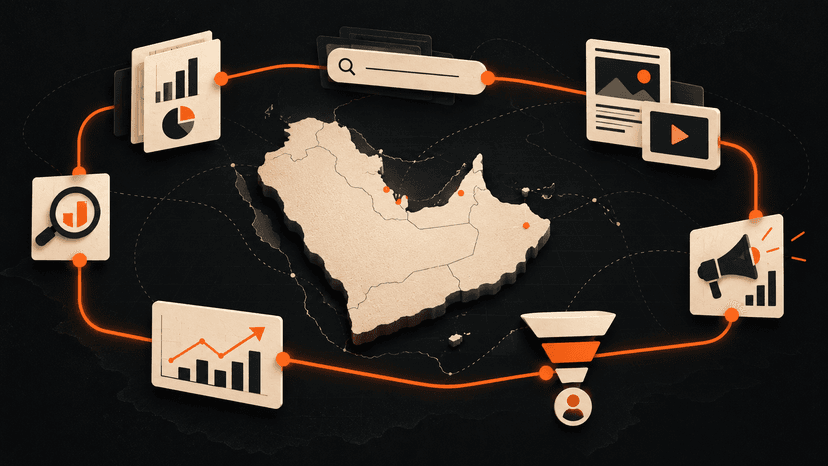
A campaign creates activity. A system links that activity to a buyer’s problem, a commercial priority and a decision the business can act on. Without that link, every channel reports its own numbers and nobody can explain how a sale happens.
Most B2B marketing in the United Arab Emirates (UAE) is not short of activity. A company can run LinkedIn ads, paid search, reports, landing pages and a CRM, and still have no reliable way to create demand. What is missing is the link between them.
Without a shared journey, each channel chases its own number. Paid media reports clicks. Social reports engagement. The website reports visits, and sales reports opportunities. Nobody can say with confidence how the whole journey works.
B2B demand generation fixes this by starting from the buyer, not the channel. It asks four things. What problem does the buyer have? What do they search for? What would help them decide? What should happen next?
The goal is not to make every channel busier. It is to make every channel contribute to the same commercial decision.
Gorilla Vibe Editorial
Market problem → buyer signal → useful content → conversion path → qualified conversation → sales feedback → next decision
Build positioning that fits the UAE and GCC market
Localising a proposition means making it useful and believable in the market where the buyer will judge it. That is more than translation. It covers the problem you lead with, the proof you show and the next step you offer.
A global message can be accurate and still feel distant. It may assume a buying process that does not apply here. It may lead with a benefit that is not the first priority in the region.
A market-ready proposition answers four questions in the buyer’s own words. For the mistakes we see most often, read what global B2B brands get wrong in the UAE.
Problem
The costly, slow or uncertain situation the buyer recognises.
Promise
The improvement the business can credibly help create.
Proof
Approved evidence that reduces uncertainty.
Path
The practical next step the buyer can take.
Do
- Lead with the problem buyers here already name
- Show proof from the region, or say plainly where it comes from
- Offer a next step that suits a first conversation
Don't
- Translate a global campaign word for word
- Promise a result you cannot show
- Ask for a long form before you have given anything
Define the commercial goal and the buying situation
Start with the commercial change marketing should support, the people who take part in the decision, and the signs that an enquiry is worth a salesperson’s time. A clear goal turns a wish to grow into a brief a team can act on.
“Generate awareness” is too broad to guide any work. “Grow in the UAE” is a business ambition. It is not yet a marketing brief.
A usable goal names five things: the market, the problem, the buying group, the action marketing should influence, and the proof of quality. Judge fit and intent apart. A large company that is not looking is not a lead. A small one that is ready to buy may be.
This is where a GCC marketing strategy differs from a list of tactics. It says which markets come first, and why.
- Priority buyer and account group
- Buying trigger and business consequence
- Decision roles and objections
- Useful next step
- Wrong-fit enquiries to turn away
Map local demand and search intent
Search demand shows how people describe their problems, the solutions they weigh and the questions they ask before they buy. Use it to shape the whole journey, not only to pick keywords for a page.
Every page needs one clear job. A service page helps a buyer weigh you up. A guide helps them solve a problem. A case study shows what you have done.
Keywords tell you the words buyers use and what they want at that moment. They do not replace useful content, good internal links and a fast, stable page on a phone.
Content marketing across the GCC works best when each piece answers one question from this map.
| Search intent, buyer question, useful content and next step | |||
|---|---|---|---|
| Intent stage | Buyer question | Useful content | Next step |
| Problem recognition | Why is delivery visibility harder as we scale? | Diagnostic article | Explore the problem |
| Solution education | How does delivery management work? | Guide or video | Understand the approach |
| Provider discovery | Delivery software UAE | Service page | Review capability |
| Comparison | What should we compare? | Evaluation framework | Use the checklist |
| Action | Book a demonstration | Conversion page | Schedule a meeting |
Connect content, media and conversion journeys
Channels work as one system when they share a point of view, lead to a page that keeps the promise, and hand each enquiry to a named person in sales.
Build one strong resource around a decision your buyer has to make. Then adapt it for search, social, video, email and sales. Each version should add context, not repeat one caption.
This is the heart of performance marketing in the UAE. Every paid campaign starts from a written guess you can test, and every call to action matches what the reader came for. See how we plan and run this work in our marketing services.
Every enquiry needs an owner, a way to qualify it and a route for feedback to reach marketing.
- 01Attract
- 02Engage
- 03Nurture
- 04Convert
- 05Expand
Measure commercial movement, not activity alone
Reach, clicks and visits help you diagnose a campaign. They are not proof of commercial success. Report what moved towards revenue, and say plainly what you cannot see.
A balanced model covers seven layers: visibility, engagement, intent, qualification, pipeline, revenue and learning. Which measures you use depends on your sales cycle and the data you have.
Write down the limits of your attribution. If offline talks or privacy controls hide part of the journey, say so. An honest gap is more useful than a precise guess.
| Measurement layer and useful evidence | |
|---|---|
| Journey layer | Useful evidence |
| Visibility | Qualified reach and priority-query visibility |
| Engagement | Engaged visits and content completion |
| Intent | Service-page visits and consultation interest |
| Qualification | Fit, role and sales acceptance |
| Pipeline | Opportunity movement and pipeline value |
| Learning | Message, audience and journey decisions |
Put the framework into a 90-day plan
Ninety days is long enough to build and test one buying journey, and short enough to hold a team’s attention. The cycle creates momentum and learning. It does not promise a fixed revenue result.
Days 1 to 30 align the goal, the audience, the proposition, the tracking and the first buying situation. Days 31 to 60 build the content, the landing journey, the media and the sales handoff. Days 61 to 90 run controlled tests, review lead quality and decide what to scale, improve, pause or look into.
When you are ready to plan your own, talk to the Gorilla Vibe team.
Align and diagnose
- Confirm commercial objective
- Audit demand and proof
- Validate tracking
Build the system
- Create priority content
- Build the conversion path
- Prepare sales handoff
Activate and learn
- Launch controlled activity
- Review lead quality
- Scale, improve or pause